
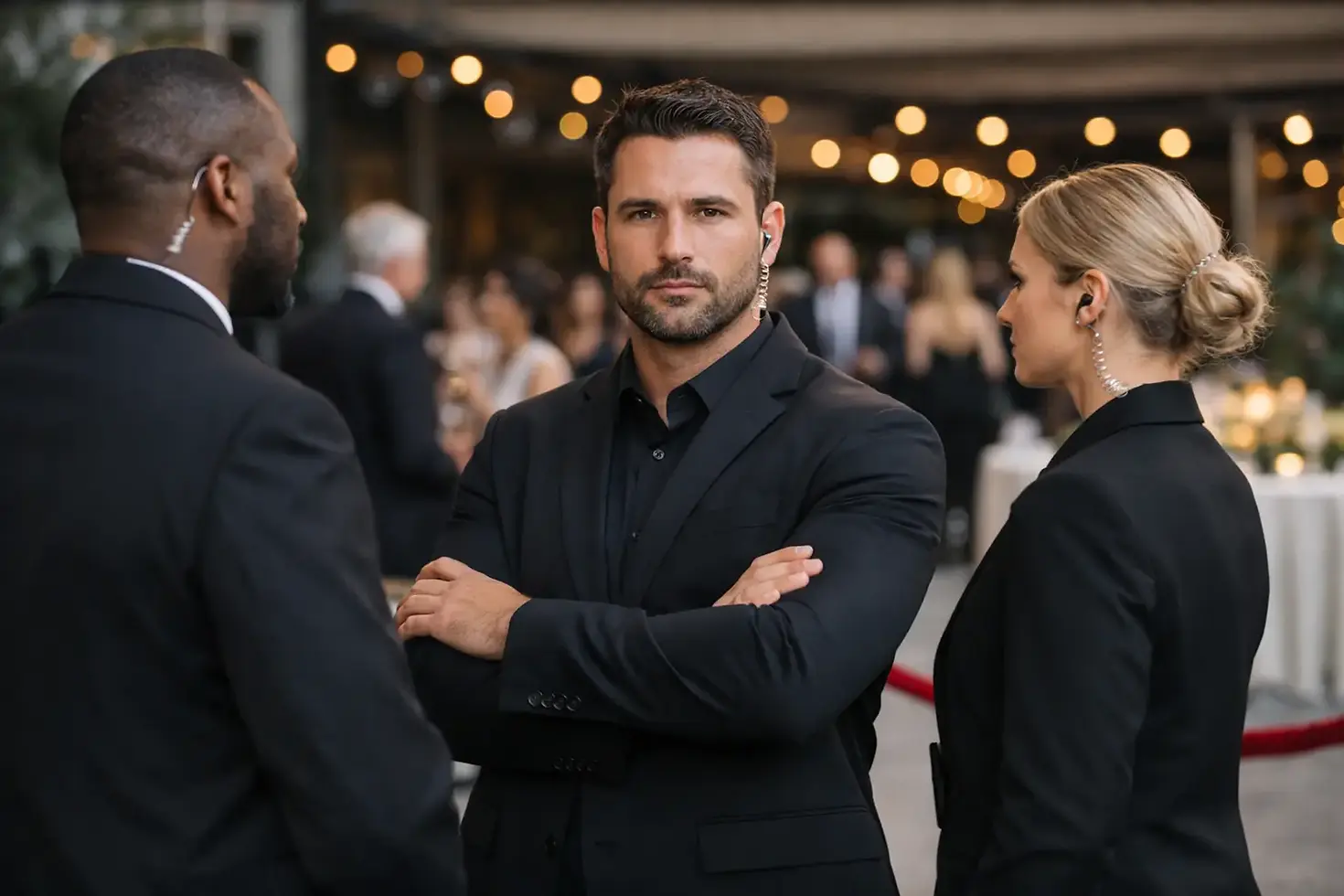
How Many Guards for an Event?
- Jun 22
- 6 min read
A 200-person private party and a 200-person public concert do not need the same security plan. That is why the first question is rarely just how many guards for an event. The real question is how many trained professionals are needed to control access, watch the crowd, respond fast, and keep the event moving without creating unnecessary cost.
For event organizers in Los Angeles, staffing too light can create obvious problems - long entry lines, unmanaged guest disputes, blind spots, and slower response when something goes wrong. Staffing too heavy can waste budget and make a polished event feel overcontrolled. The right number sits in the middle, based on risk, layout, timing, and the kind of crowd you expect.
How many guards for an event depends on risk, not just headcount
Many people look for a simple ratio, and there are common starting points. For a low-risk private event with controlled access, some planners begin around one guard per 75 to 100 guests. For a higher-risk event, that number can move closer to one guard per 25 to 50 attendees. Those figures can help with early budgeting, but they are not a staffing plan.
A guest count tells you how many people may be present. It does not tell you how they will move, whether alcohol will be served, how many entrances need to be controlled, whether VIPs are attending, or how quickly a guard can reach a parking lot incident from the main floor. Security staffing should be built around exposure, not just attendance.
That is especially true in Los Angeles, where venue type, neighborhood traffic, parking conditions, and arrival patterns can change the workload fast. A rooftop event in a dense area, a warehouse activation, and a residential gathering in the Hills may all have the same attendance number but very different security demands.
The factors that determine how many guards for an event
Venue layout and access points
A compact ballroom with one public entrance is easier to secure than a spread-out venue with multiple doors, loading areas, stairwells, and parking access. Every point where people can enter, exit, or bypass control adds staffing pressure.
If your event has two guest entrances, a vendor entrance, backstage access, and an open parking area, one or two guards will not be enough even for a moderate crowd. A guard posted at entry cannot also patrol a perimeter or respond to an incident across the site.
Public or private event type
Private guest-list events are usually more predictable. Public events, ticketed events, and open-access gatherings tend to need more coverage because you have less control over attendance flow and guest behavior.
Public-facing events often require stronger bag checks, line management, credential checks, and crowd observation. If your team expects walk-ups, denied entry, or disputes at the gate, those functions should be staffed separately from roaming coverage.
Alcohol service
Alcohol changes the staffing calculation quickly. It increases the chance of arguments, impaired judgment, disorderly behavior, and medical issues. It also raises the need for visible guard presence in transition areas like bars, restrooms, smoking sections, and parking lots.
If alcohol is being served, a ratio that looked reasonable on paper may no longer be enough. In many cases, you need both fixed-post personnel and mobile guards who can intervene early before a minor issue becomes a removal or emergency response situation.
Time of day and event duration
Night events usually require more active oversight than daytime functions. Visibility drops, parking lots become more vulnerable, and guest behavior can change as the event runs longer.
A two-hour corporate reception may need a lighter footprint than a six-hour festival, even with similar attendance. Fatigue matters too. If the event is long, staggered breaks and relief coverage need to be built into the schedule so your team stays alert through the final exit.
Crowd profile and expected behavior
A shareholder meeting, a celebrity appearance, a live music event, and a youth sports tournament all generate different security demands. Some crowds are calm and structured. Others are fast-moving, emotional, or prone to congestion and conflict.
Age group matters. So does the reason people are attending. When emotion, competition, alcohol, or high visibility are part of the event, staffing generally needs to increase.
Special risks and asset exposure
If there are VIPs, cash handling, expensive equipment, restricted areas, or protest potential, your guard count should rise accordingly. The same goes for events with backstage access, green rooms, production gear, or valuable sponsor installations.
In those cases, event security is doing more than watching the crowd. It is protecting people, property, and sensitive areas at the same time.
What a basic event security deployment can look like
For a small, low-risk private event, coverage might include one guard at entry and one roaming guard handling perimeter checks and guest issues. That can work when attendance is limited, access is controlled, and there is no alcohol or elevated threat factor.
For a mid-size event, planners often need more defined roles. One team may handle check-in and access control, another may patrol interior spaces, and another may cover the exterior or parking area. Once the event spreads across multiple zones, specialized posts become more effective than relying on one floating guard to cover everything.
Large events usually require layered coverage. That may include a supervisor, entry guards, bag check personnel, roaming interior guards, parking lot patrol, restricted-area control, and a team ready to respond to incidents. Technology can reduce blind spots, but it does not replace trained personnel at key positions.
This is where a technology-first model helps. Integrated cameras, monitored access points, radios, and live coordination can make a guard team more effective, which may prevent overstaffing while still maintaining strong coverage. Wings Security Services Inc. often builds plans this way - combining on-site personnel with smart monitoring so the team can see more, respond faster, and cover the site with purpose.
Common staffing mistakes event organizers make
The biggest mistake is planning around the guest count alone. A 500-person event with one controlled entrance may be easier to manage than a 250-person event spread across indoor and outdoor zones with alcohol service and open parking.
Another mistake is forgetting the exterior. Problems do not stay neatly inside the venue. Parking lots, sidewalks, rideshare pickup points, and loading areas often generate the first and last security issues of the night.
Some organizers also underestimate entry operations. If guests are delayed at the gate, frustration builds fast. If your event needs ID checks, credential validation, bag inspection, or ticket scanning, that workload needs dedicated staffing. Otherwise, your security team gets trapped at the front while the rest of the event goes uncovered.
The last mistake is ignoring escalation. Not every issue needs a major response, but every event needs a clear path for handling disruptive guests, medical incidents, unauthorized access, or emergency evacuation. That means staffing for command and response, not just presence.
How to estimate your event guard needs before requesting a quote
Start with your attendance range, then map the site. Count entrances, exits, restricted zones, parking areas, and any spaces where crowding is likely. Next, consider whether the event is public or private, whether alcohol is involved, and whether any VIPs or sensitive assets are on site.
Then think in posts, not just total guards. Ask yourself who is controlling entry, who is roaming, who is watching the exterior, and who is supervising the operation. This usually gives a more realistic number than a simple guest-to-guard ratio.
If your event has multiple moving parts, ask for a site-specific assessment rather than a generic estimate. A qualified provider should want details about schedule, layout, guest type, and operational concerns before recommending coverage. If the answer comes back too fast and too simple, it may not reflect the actual risk.
The right number is the number that closes the gaps
So, how many guards for an event? Enough to secure the entrances, protect the vulnerable areas, keep the crowd moving, and respond without delay. Sometimes that is two. Sometimes it is ten. The difference comes down to exposure, not guesswork.
Strong event security should feel controlled, visible, and ready - never excessive, never absent, and never improvised. If you plan staffing around the real conditions on the ground, you protect your guests, your reputation, and the event itself with far more confidence.



Comments