

Surveillance Monitoring for Business Security
- Jun 27
- 6 min read
A break-in rarely starts with smashed glass. More often, it starts with a blind spot, a door left unsecured, a delivery entrance with no oversight, or an after-hours gap no one noticed until inventory went missing. That is where surveillance monitoring for business security changes the equation. It gives business owners and property managers a way to spot risk early, verify what is happening in real time, and respond before a small problem turns into a costly incident.
For Los Angeles businesses, that matters. Commercial properties here deal with a wide range of threats depending on location, foot traffic, operating hours, and site layout. A retail storefront faces different pressure than a warehouse yard, medical office, apartment complex, or corporate building. The common issue is not simply whether cameras are installed. It is whether anyone is actively monitoring, assessing, and acting on what those cameras reveal.
What surveillance monitoring actually does
Many businesses already have cameras. That alone does not create security coverage. Recorded footage is useful after an incident, but it does little to stop trespassing, theft, vandalism, unauthorized access, or suspicious loitering as it unfolds. Surveillance monitoring adds active oversight to the system.
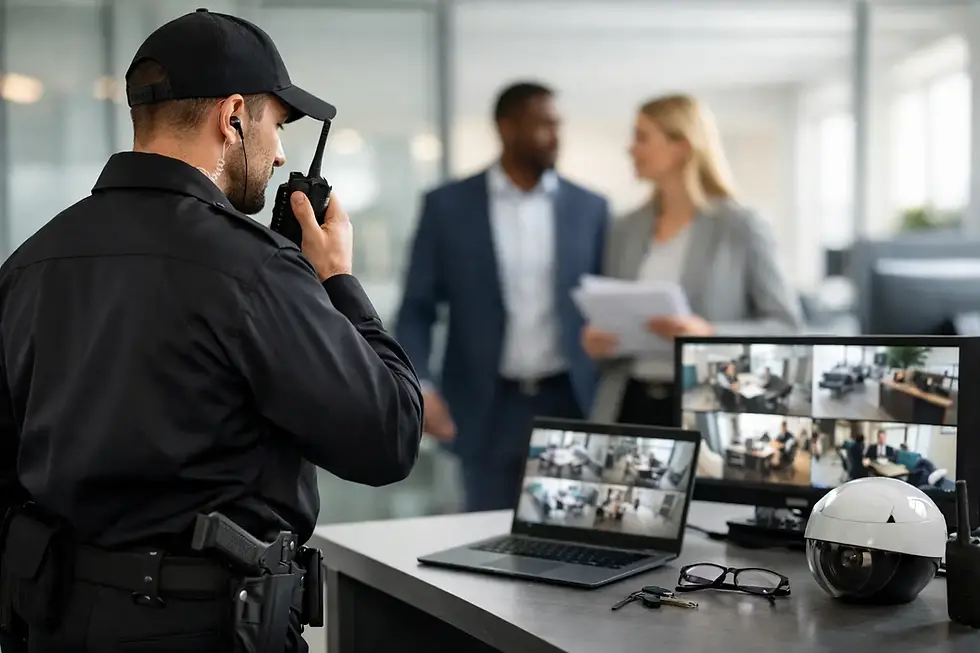
That means video feeds are being observed, alerts are being reviewed, and unusual activity is being escalated according to a clear response plan. Depending on the property, that response may involve notifying on-site security personnel, dispatching a mobile patrol unit, contacting management, locking down an access point, or calling law enforcement when a threat meets that threshold.
The difference is timing. Passive cameras document. Active monitoring supports intervention.
Why surveillance monitoring for business security matters
The strongest argument for surveillance monitoring for business security is not just crime prevention. It is operational control. Security failures interrupt business. They lead to damaged property, employee safety concerns, tenant complaints, lost merchandise, insurance complications, and downtime that can affect revenue and reputation.
A monitored system helps reduce those gaps in several ways. First, it increases visibility across entry points, parking areas, loading zones, interior common areas, and vulnerable perimeters. Second, it shortens the time between detection and response. Third, it creates accountability because incidents can be verified quickly rather than guessed at after the fact.
This is especially valuable for businesses that do not have full-time staff in every area of the property. Overnight shifts, multi-building facilities, and sites with public access tend to have predictable weak points. Monitoring closes distance between the event and the decision-maker.
Cameras alone are not a full security plan
One of the most common mistakes businesses make is assuming camera coverage equals security coverage. It does not. A camera can capture a person entering a restricted space, but if no one sees it until the next morning, the opportunity to contain the situation is gone.
The better approach is layered protection. Surveillance should work with trained personnel, access control, lighting, alarm triggers, and site-specific procedures. If a side gate is forced open, the right system does more than record the event. It alerts the right people, confirms the threat, and starts a response.
That is why technology-first security works best when it is paired with trained human judgment. Automated alerts are useful, but they still require interpretation. A blowing plastic bag is not the same as a person casing a loading dock. A delivery driver at the wrong entrance is not the same as unauthorized entry after hours. Monitoring becomes effective when someone can tell the difference and act with discipline.
Where businesses benefit most from active monitoring
Not every business needs the same surveillance setup. A small office suite may need focused coverage at entrances and parking. A retail operation may need close attention on customer-facing areas, registers, stockrooms, and exterior access points. Industrial properties usually need broader perimeter awareness, yard visibility, and after-hours intrusion detection.
In Los Angeles, multi-tenant commercial properties and mixed-use buildings often benefit from monitoring because they have shared access points and fluctuating traffic patterns. Event venues and temporary activations also present a different challenge. Crowds, vendor movement, equipment load-in, and changing access routes can create confusion fast. In those settings, monitoring helps security teams stay ahead of bottlenecks and identify concerns before they spread.
The right plan depends on what needs protection most. For some sites, the priority is theft deterrence. For others, it is liability reduction, employee safety, or better control over who enters and exits the property.
How monitored surveillance improves response speed
Response time is where many security plans either hold up or fail. When an alarm goes off without visual verification, managers are left making decisions with limited information. That often leads to delay, false alarms, or overreaction.
With monitored video, the response can be more precise. Security personnel can confirm whether someone is attempting forced entry, lingering in a restricted area, bypassing access procedures, or moving through a blind spot that should be clear. That information matters because it shapes the next move.
A fast response is only useful if it is the right one. If an employee forgot their badge, the issue may be resolved at the access point. If a person is tampering with equipment in a secured lot, that calls for immediate escalation. Real-time monitoring supports faster decisions because it gives context, not just noise.
The trade-offs businesses should think through
More surveillance is not automatically better. Coverage has to be strategic. Too few cameras leave gaps, but too many poorly placed cameras can overwhelm a monitoring team without improving outcomes. The same is true for alerts. If a system generates constant low-value notifications, important events can get buried.
There is also the question of privacy and policy. Businesses need to monitor lawfully and communicate clearly with employees, tenants, or visitors where required. Interior camera placement should be guided by legitimate security needs, not blanket visibility for its own sake. A professional security partner can help align monitoring practices with operational goals and legal considerations.
Cost is another factor, but it should be viewed against the real cost of inaction. Replacing stolen equipment, repairing vandalism, addressing injury claims, or losing tenants after repeated incidents is rarely cheaper than investing in a system that reduces exposure. The key is right-sizing the solution instead of buying technology that does not match the actual risk profile.
Choosing a surveillance monitoring strategy that fits the site
A strong monitoring strategy starts with assessment, not equipment. Businesses need to understand where incidents are most likely to occur, when the property is most vulnerable, and how a response should be handled if an event is detected.
That usually means looking at access points, traffic patterns, historical issues, lighting conditions, hours of operation, and whether there is any on-site security presence already in place. From there, the monitoring plan can be built around the site rather than forced into a generic package.
For some businesses, remote monitoring supported by patrol response is a practical fit. For others, especially high-traffic or high-value environments, the best approach is integrated protection with on-site guards, monitored cameras, and access control working together. Wings Security Services Inc. often sees the strongest results when businesses stop treating security tools as separate systems and start managing them as one coordinated operation.
What to expect from a serious provider
A serious surveillance monitoring partner does more than install cameras and hand over an app. The provider should help define response protocols, identify weak points, recommend camera placement based on actual site behavior, and coordinate monitoring with personnel on the ground if needed.
Just as important, they should understand the area. Los Angeles is not one security environment. Risks in Downtown, Hollywood, the Valley, or industrial corridors near major transit routes do not look the same. Local familiarity affects deployment, patrol routing, and how quickly support can be positioned when something happens.
Businesses should also expect communication. If monitoring identifies a pattern, such as repeated after-hours loitering or a delivery entrance being left unsecured, that information should be reported and addressed. Good monitoring does not just react to incidents. It helps prevent the next one.
Security works best when it is active, disciplined, and built around the property it protects. If your cameras are only giving you footage after the damage is done, the system is doing half the job. The right monitoring strategy gives you eyes on the risk, a plan for response, and more control over what happens on your site when it matters most.


Comments